The data center map
On this page
The data center map shows where the internet and AI physically live: data-center buildings, the largest AI supercomputers, the cloud regions of the big cloud providers, and Google's and Meta's data-center campuses, on one world map with a page for every country and U.S. state.
#Open the map
Select Data centers in the ribbon, or search for data center map. A search such as data centers in virginia or ai data centers in texas opens that state's page; data centers in germany opens the country's.
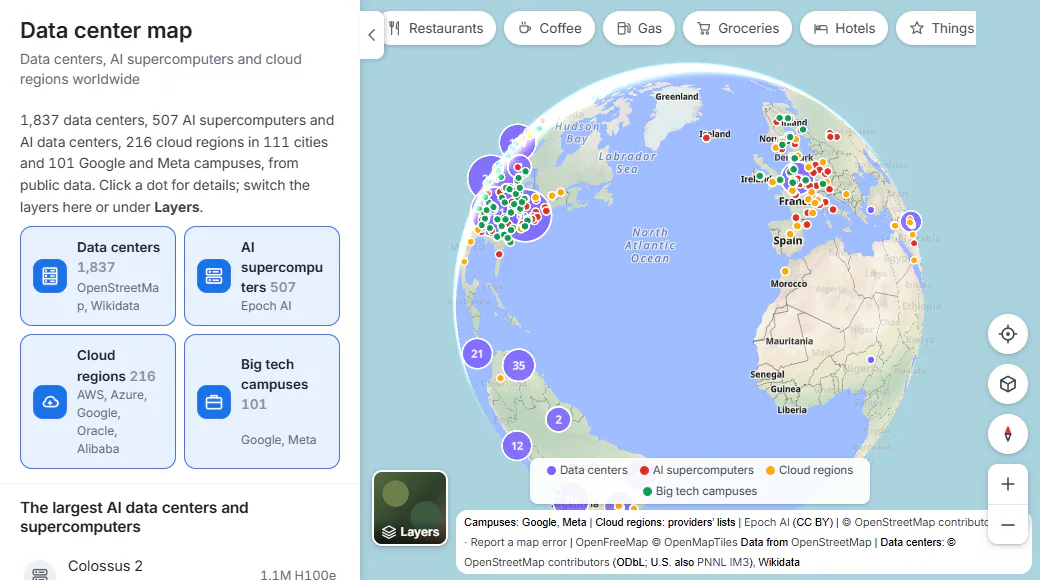
The data center map turns on all four layers. Their switches, with counts, are at the top of the panel.
- 1Four layers, each with its count and source
- 2Color key
- 3Dots and numbered clusters: zoom in to split them
#The four layers
| Layer | Color | What it shows |
|---|---|---|
| Data centers | Purple | Data-center buildings and campuses mapped in OpenStreetMap, plus, in the United States, a national atlas of data centers, and data centers listed in Wikidata. |
| AI supercomputers | Red | The largest AI data centers and AI supercomputers, from Epoch AI's public datasets, with their owner, chips and computing power. |
| Cloud regions | Yellow | The regions of Amazon Web Services, Microsoft Azure, Google Cloud, Oracle Cloud and Alibaba Cloud, drawn at the city each provider names. |
| Big tech campuses | Green | Google's and Meta's data-center campuses, as the companies publish them, drawn at the town. |
Turn each on or off with its switch in the panel or in Layers, under Internet infrastructure. Where dots crowd together they merge into a numbered cluster; select it to zoom in and split it.
#Read a site
Select a dot for its details. Depending on what the sources know, the pop-up gives:
- The name, the kind of site (data center, AI data center, AI supercomputer, cloud region) and the owner or operator.
- Size: floor area, or power in megawatts.
- Computing power in H100-equivalents (H100e), Epoch AI's measure of AI computing power in units of one NVIDIA H100 chip, and the chips used.
- When it opened, and whether it is still under construction.
- Links: Details (for sites mapped in OpenStreetMap) opens the site's place page with its address and nearby street-level photos; Website and Wikipedia when known.
- Source: which dataset the dot comes from.
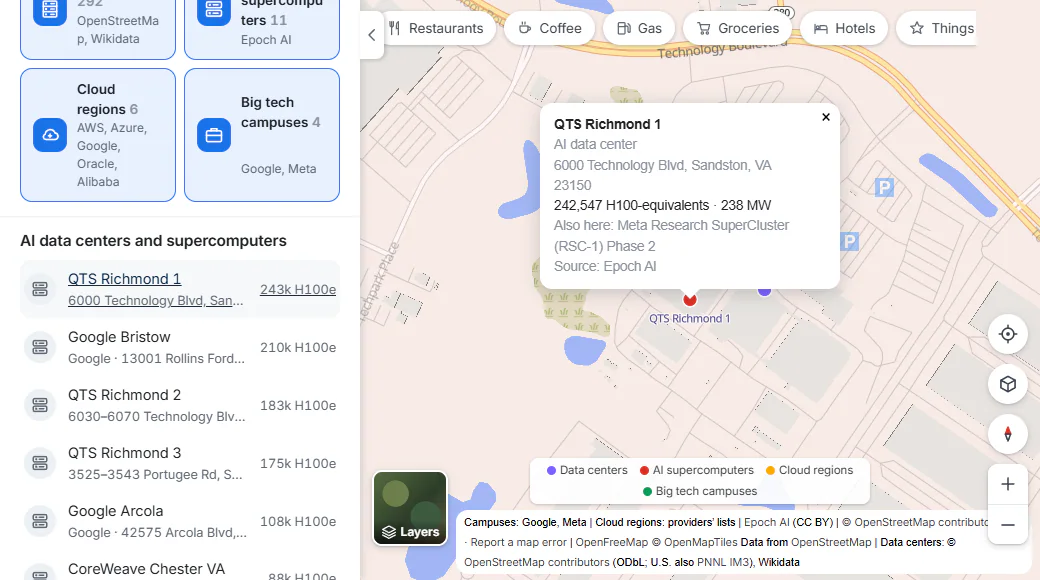
Selecting a row in a state's list flies to the site and opens its pop-up.
- 1Select a row to fly to the site
- 2The pop-up: name, kind, operator and what is known about it
Cloud regions and campuses are drawn at the city or town their operators name, not at the buildings, which the companies do not publish. A dot that lists several regions or campuses means they share a town.
#Countries and states
The overview lists The largest AI data centers and supercomputers, the number of Cloud regions per provider, the count of sites By country and By U.S. state. Select a country or state for its own page, which lists its AI data centers, its cloud regions, its campuses and its data centers, each row flying the map to the site. Every country's Maps page also has a Data centers button.
#Find more in OpenStreetMap
The layers hold the sites their sources list. OpenStreetMap volunteers have mapped many more buildings: zoom in anywhere and select Data centers under More in OpenStreetMap in the panel (or search for data centers) to look for data-center buildings in the part of the map you are viewing.
#Common questions
What is an H100-equivalent?
A way of comparing AI computing power: the number of NVIDIA H100 chips that would give the same performance. Epoch AI, which publishes the estimates, converts other chips into this unit so different sites can be compared.
Why is my local data center missing?
It may not be mapped in OpenStreetMap or listed in the other sources yet. If you know where it is, you can add it to OpenStreetMap; the map picks up new sites when its data is refreshed.
Why is a cloud region shown in the middle of a city?
Cloud providers publish the city or area of each region, not the address of its buildings, so the dot marks the city.
How often is the data updated?
Each source is refreshed regularly on its own schedule, so a newly announced site can take a while to appear.